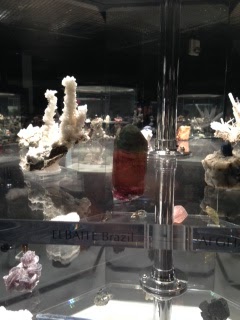
I originally wanted to share the newest Pittsburgh Glass Center Exhibit, Lifeforms, with you today, but I haven't had a chance to visit it yet. Hopefully I will get to attend and will report the next time I post here. So today, I thought I'd share some pretties with you from the Carnegie Museum here in Pittsburgh.
When I first walked past these items, I thought they were ceramic. Upon further inspection, I saw that they were glass. They are simply gorgeous! They are made with what I can only assume are murrini (small pieces of colorful designs in glass, which are shaped in rod form and then nipped into small pieces to reveal the design).
The gems in the museum here in Pittsburgh are amazing - while the ammonite display in the Houston museum was incredible, they don't have such a huge display of gems as we do here. I took tons of photos - I can't possible share them all here, but I'll share some of the more interesting photos with you.
I have to admit I haven't ever heard of many of these gems, and crystals, but wow were they gorgeous! I have to apologize if some of the photos are a little hard to see, the exhibit is very dark with bad lighting for taking photos. But I couldn't resist.
There was one exhibit I particularly liked, it was called Curious Concretions. The text reads as follows:
"concretions form in soft, sedimentary rocks when minerals like calcite, siderite or pyrite grow around a kernel or nucleus within the rock, somtimes a speck of carbon or a fossil, and cement the -- sediments into a ball, rod or disk"
They are quite beautiful, and my favorite is the Pyrite Sun, found in Illinois (third photo in this series).
Finally, they have an exhibit called Pennsylvania Minerals. I found it interesting to see what wonderful things are found in Pennsylvania. I've heard of the wonderful mines out west, but was glad to see we grow some pretty neat things out East!
I hope you enjoyed my little tour of the Carnegie Museum of History Gem Hall in Pittsburgh, PA! Next time I will bring you an exhibit from the Pittsburgh Glass Center!
Susan Kennedy
Showing posts with label gems. Show all posts
Monday, February 22, 2016
Wednesday, December 9, 2015
Color me enchanted! A book review...
I sat down to write this post on 2 books in my art/inspiration/history library that I adore. And found a new book by the author, Victoria Finlay. I only wonder if I can wait until the holidays to purchase it. You know its on my list right away! OK - back to the regularly scheduled post...
When I need a go to gift for a friend I turn to the work of author Victoria Finlay. Almost everyone I know would find either of her first 2 books interesting. Gems, history, drama, folktales, color, pigments, each, science, paint, art.... see what I mean? I wanted to introduce these to you, for your list or as gifts... since it IS that time of year.
First: Color: a natural history of the palette.
This book is a treat. Divided into the colors of the rainbow it delves into origins, materials, organic sources, scientific methods, history, travel, culture... The author shares her travel tales, her detailed and thorough research, both historical and cultural. Its a behind the scenes look into things that are so familiar and remain a complete mystery!
![]() |
| Color by V. Finlay. Available here |
From the back cover:
- Cleopatra used saffron - a source of the color yellow - for seduction...
- Extracted from an Afghan mine, the blue "ultramarine" used by Michelangelo was so expensive he couldn't afford to buy it himself.
- Since ancient times, carmine red - still found in lipsticks and Cherry Coke - has come from the blood of insects.
![]() |
| Snippets from "Color..." |
"If you open up a box of paints, there are numerous such stories hidden inside it. There are stories of sacredness and profanity, of nostalgia and invention, of secrecy and myth, of luxury and texture, of profit and loss, of fading and poison, or cruelty and greed, and of the determination of some people to let nothing stop them in the pursuit of beauty." ( page24)
Second: Jewels- A secret History
![]() |
| Jewels by V. Finlay available here |
Im sure you have heard of the infamous and tragic Hope diamond, of Mikimoto and the first cultured pearls. But what of Whitby, the town jet built? The emerald city of Sikait? The amber washing championships on Jantar, Poland? I didn't think so! These and more tales await you in the pages of "Jewels"! I am the first to admit that I am a "gemstone junkie" and that I most frequently use stones in my beadwork. But this is a multicultural exploration into places, gems, folklore... that appeals to me on so many levels!
Looking inside this one on Amazon, I may have actually sealed out loud in excitement. COLOR and ART HISTORY. I am in heaven. Cave paintings! Tyrian purple and Egyptian blue, gilded Medieval painting, sepia photography...
![]() |
| Snippets from "Jewels" |
And most recently: The BRILLIANT history of Color in Art
![]() |
| Finalys' newest! Im so excited! On Amazon... |
from the back cover:
- Cleopatra made purple the royal color of the Western world. Her favorite was made with rotten shellfish soaked in urine.
- Cobalt blue was the key evidence in a infamous trial involving Nazi collaboration and a forged Vermeer.
- Van Gogh used chrome yellow beautifully in his paintings - but he probably shouldn't have eaten it.
( I searched for this last night at Barnes & Noble. To look, maybe to bring it home... Sadly their one copy wasn't not the shelf. So for now - it remains on my Wish list.)
I know that was a very biased, enthusiastic review. But if all I achieve is to have you look up these books and consider them... they speak for themselves. Great gifts - for yourself, or your art/jewelry/history/folklore friends!
Labels:
art
,
books
,
color
,
famous
,
folklore
,
gems
,
gift ideas
,
history
,
inspiration
,
magic
,
mystery
,
painting.
Friday, June 19, 2015
Folklore Friday - Garnets
I can never tire of garnets...
January's birthstone - from deep wine red to amber brown to forest green...
My only real jewelry time of late has been vicarious, browsing a few hardback library tomes on historical jewelry. So in light of my absence from the studio; I decided to show you garnets from those ancient times. Ancient jewelry has always fascinated me. Materials used, cultural and historical context of pieces, uses and meaning of personal adornments. Jewelry was worn through out history and time, yet carries such meaning with each style and time period....
early 14c., metathesized from Old French grenat "garnet," originally an adjective, "of a dark red color," from Medieval Latin granatum, originally an adjective, "of dark red color," perhaps abstracted from pomegranate (q.v.), from the stone's resemblance either to the shape of the seeds or the color of the pulp. But perhaps the word is from Medieval Latin granum "grain," in its sense of "cochineal, red dye."
|
||
|
|
|
|
|
|
|
|
|
Basic Garnet info:
- Garnet occurs in every color except blue and most varieties are named for their color. Rhodolite is a purplish red, hessonite is the name for an orange, cinnamon, or pinkish variety. Tsavorite is the name given to dark green grossularite. Uvarovite and demantoid are also green varieties.
- Garnets range from a 7.0 to 7.5 on the Mohs scale of hardness and are found in the U.S. (Arizona), South Africa, Argentina, Australia, Brazil, Myanmar (Burma), Scotland, Switzerland and Tanzania .
- Garnet's powers include healing, strength, and protection and it is often worn to relieve inflammations of the skin. It is also believed to regulate the heart and blood flow and aid in curing depression. In earlier times, garnets were exchanged as gifts between friends to demonstrate their affection for each other and to insure that they meet again.
I hope you have enjoyed this ancient sampler. I didn't even touch upon the Renaissance, the Victorian era... so much rich history. Perhaps you'll find inspiration here, it will keep me satiated until I return to the studio!
Labels:
ancient jewelry
,
art history
,
birthstone
,
celtic
,
folklore
,
garnets
,
gems
,
gemstones
,
gold
,
Roman
Friday, August 22, 2014
Folklore Friday:
Hello!
As you read this - I am at Bead Fest in Philly. I am selling, buying, chatting, teaching... and there may be coffee and wine in there somewhere too. Please enjoy this post; it was the first in a series of folklore/birthstone pieces I wrote for Beads of Clay. I look forward to reprising these, and finishing the zodiac here on AJE!
Peridot, the August birthstone...
![]() |
| Image credit: The Collector |
The green of summer! Lush plants blooming in the sunshine! Peridot gets its green color from iron, and is always green. Its a fragile stone ( 6.5 on the Moh's scale) softer than all of the other translucent gems; only one step harder than glass! Its formed from olivine, and like diamonds is formed under the Earths's crust - brought to light by volcanic activity.
The name stems from the Greek "Peridona" meaning plentiful. This refers to the attributes of peridot - not its availability. It was believed to protect the wearer from evil spirits and adversity. It is believed to be a stone of increase, bringing warmth, prosperity and well being to the wearer.
![]() |
| My peridot palette: Peridot chips in the center, paired with my ceramic pendants in related hues and silks from Marsha Neal Studio. |
A few historical notes on Peridot:
- The oldest examples are Egyptian, dating back to 2000 BC. Peridot was plentiful on the island of Zabargad, off the Egyptian coast in the Red Sea.
- The Romans called peridot "Emerald of the evening" as its color is more intense in gentle light.
- Medieval metal smiths were introduced to Peridot after the Crusades "imported" goods from the Middle East. It was used in reliquaries and ecclesiastical items like the Shrine of the Magi in Cologne Cathedral. (on the left)
- Peridot is mined in Burma, China, Arizona, and Pakistan - where new mining in the 1990's created a resurgence and renewed interest in the stone.
- The largest faceted specimen? The Smithsonian in DC - toping the scales at 310 carats! (opening pix)
- In 2003 NASA observed large areas of the planet Mars covered in peridot! So much for the 'red' planet...
Thanks for reading! Let me know what you think and how you used peridot in your designs.
Jenny
www.jdaviesreazor.com
Sources:
- wikipedia
- jewelfinder.net
- gemstone.org
- Jewels: a Secret History by V. Finlay
- The Curious Lore of Precious Stones by G. F. Kunz
- The Book of Stones by R. Simmons & N. Ashian
Friday, March 21, 2014
Folklore Friday - Amethyst
(Hello all - I am reprising a series of folklore posts I started a few years back for the Beads of Clay blog. I was researching gemstones/birthstones, their folklore, symbolism, and any famous - or infamous - specimens. While I am off a month as to the birthstones calendar - let me start here with Amethyst, February's Birthstone. Enjoy!)
Folklore Friday - Amethyst.
Stay tuned for more folklore - coming soon!
Folklore Friday - Amethyst.
Species: Quartz
Color: Purple, violet, pale red-violet
Chemical composition: SiO, silicon dioxide
Crystal system: (Trigonal), hexagonal prisms
Hardness: 7 (Mohs scale)
Amethyst location and depositsThe most important deposits are in Brazil, namely the "Palmeira" amethysts of Rio Grande do Sul and the "Maraba" amethysts of Para. Other deposits are found in Bolivia, Canada, India, Madagascar, Mexico, Myanmar (Burma), Namibia, Russia, Sri Lanka, United States (Arizona), Uruguay and Zambia.
Amethyst is a variety of quartz which occurs in transparent light to dark purple. The darker more intense colors are more valuable than the lighter smoky or lavender color. Dark rich, royal colors of amethyst have been treasured by kings and queens for centuries and can be traced back to the Minoan period in Greece (c. 2500 B.C.). During the 15th century the French fleur-de-lis brooch could only be worn by the Royal family on ceremonial occasions. (Logical as purple has long been a color associated with royalty - due to the nature of the rare dyes used to create the color.)
![]() | |
|
- The name comes from the Ancient Greek á¼€ a- ("not") and μÎθυστος methustos ("intoxicated"), a reference to the belief that the stone protected its owner from drunkenness. The ancient Greeks and Romans wore amethyst and made drinking vessels of it in the belief that it would prevent intoxication.
- Medieval Bishop's wore amethyst rings - in an effort to keep these powerful men sober and in control of their faculties!
- Amethyst beads have been unearthed in Anglo Saxon graves in England.
- In the Egyptian book of the dead, instructions are given for placing heart shaped amethysts on the body of the deceased.
- By far my favorite treasure I have discovered about amethyst? This myth from Ancient Greece - by way of a romantic French troubadour of the 16th century :
Dionysus, the god of intoxication, of wine, and grapes was pursuing a maiden named Amethystos, who refused his affections. Amethystos prayed to the gods to remain chaste, a prayer which the goddess Artemis answered, transforming her into a white stone. Humbled by Amethystos's desire to remain chaste, Dionysus poured wine over the stone as an offering, dyeing the crystals purple.
Variations of the story include that Dionysus had been insulted by a mortal and swore to slay the next mortal who crossed his path, creating fierce tigers to carry out his wrath. The mortal turned out to be a beautiful young woman, Amethystos, who was on her way to pay tribute to Artemis. Her life was spared by Artemis, who transformed the maiden into a statue of pure crystalline quartz to protect her from the brutal claws. Dionysus wept tears of wine in remorse for his action at the sight of the beautiful statue. The god's tears then stained the quartz purple.
![]() |
Portrait of Roman Emperor Caracalla; Amethyst intaglio, ca. 212 CE.
From the treasury of the Sainte-Chapelle in Paris.
|
Attributes of Amethyst:
- thought to be helpful in overcoming addiction.
- used for hearing disorders, insomnia, headaches and other pain.
- Worn to make the wearer gentle and amiable.
- Amethyst powers include: dreams, healing, peace, love, spiritual upliftment, courage, protection against thieves, and happiness.
![]() |
The largest Amethyst geode in the world,
The Empress of Uruguay,
resides in The Crystal Caves in Australia. (zivajewels.com)
Thanks to Wikipedia, Bernardine.com and gemselect.com.
|
Stay tuned for more folklore - coming soon!
What's YOUR favorite gemstone?
Jenny
www.jdaviesreazor.com
Friday, January 24, 2014
Freeform Friday - guilty pleasures
Polar vortex. Polar plunge. Snowmageddon. Whatever. It's a snow storm. Its a snow day. When I was teaching full time, I looked forward to a snow day as much as any student. If a teacher tells you they don't enjoy a snow day... well, they may need coffee, or wine. Because really? An unlooked for day of freedom, at home, warm and cozy? Bonus.
With the latest forecast for the Mid-Atlantic this week, I made sure to stock up on the essentials. (Altho I did make an Arctic expedition to the convenience store for cream.) I am a freelance teacher now, but the ingrained response to a snow day still takes hold of me. I don't do work, even though I usually work from home. There are tiles to sculpt, blogs to write... Nope. If its snowing - I can play...
Bead embroidery feels like play. Not because its easy - quite the opposite. But its not my normal, chosen medium. Its something I am experimenting with, and I feel no pressure to produce work for a show. I like trying out pieces I have created in polymer, earthenware or stoneware clay - and seeing how they blossom enmeshed in wee tiny seed beads. The pieces are small, so I don't feel an acute loss if it has to be scrapped/torn apart/unstitched. The seed beads seem plentiful in my stash, and can be reclaimed from a piece gone wrong... So I drink coffee, watch Netflix, listen to dogs dream... and I bead the snow day away. Here are a few of my trial pieces from this winter... and we have had a few snow days here in Delaware! I would appreciate feedback as I continue to experiment with a very new (to me) medium!
![]() |
1. polymer cab. The Magician/Tarot image, peyote bezel
2. Steampunk angel - polymer wings, antique doll, gears
3. Triple butterfly - stoneware cab, "glaze tear" assorted beads
4. The newest one - earthenware goddess pendant. I was playing with gems here, lapis, moonstone, pearls. I strive for balanced asymmetry, yet ended up a little crooked.
5. Triskele goddess - started it all! Great tutorial from NoEasyBeads on Etsy.
6. Stoneware goddess cab, green garnet, peridot...
What is your (bead/art/jewelry) guilty pleasure?
I look forward to hearing from you... now I have to get back to work!
Jenny
www.jdaviesreazor.com
Labels:
bead embroidery
,
cabochons
,
cabs
,
chocolate
,
coffee
,
earthenware
,
gems
,
guilty pleasures
,
polymer
,
seed beads
,
snow day
,
steampunk
,
stoneware
,
weather
Subscribe to:
Posts
(
Atom
)