Showing posts with label design process. Show all posts

Wednesday, June 17, 2015

A Touchy Subject.

I am talking about design collisions.  In the beading world this is a very touchy subject and I do want to clear up a predominant issue.  Can design collisions be avoided?  No!  They are bound to happen.  There are so many beading designers out there compared to the amount of stitches that exist.


I also want to be clear this post is not about copying that is a separate issue altogether.  In my opinion copying is intentional.  When getting to the stage that I am with beading it is more fun to dump some beads on your tray and start playing, using the knowledge I have gained from the vast amount of great bead designers out there.  A stitch can be manipulated or other beads can be incorporated in a new way to make a design your own.  Even use of a different thread path can create a new design.  However, once I have come up with something I that would consider making a tutorial the next step is to see if someone already thought of it.

Sometimes it is real easy if you are designing with new to the market beads.  A few searches on Pinterest, Google and even Etsy and you know right away you can claim it as your design.  Like this one.


I still have to get some more crescent beads and kheops to write the tutorial but you get the idea.

Sometimes it is very hard.  In the seed beading community there are so many tags and descriptions that it is impossible to search them all.

A few months ago I thought I was pretty clever coming up with this design.
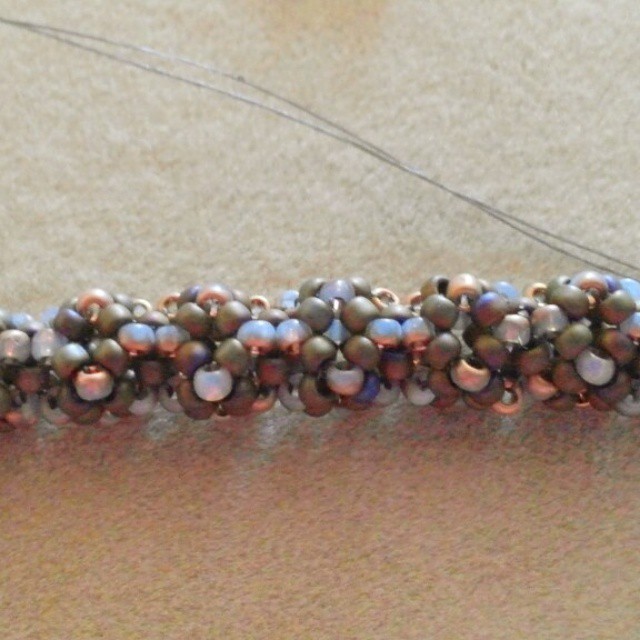
It is a really awesome thread path inspired by a stitch called pondo.  I had run out of the beads so I set it aside with the intention of writing a tutorial.  One day, you know those days you can get lost on Pinterest, I was just searching for inspiration and came across this blog post from Gwenbeads.

Yep she did it first.  Whew I didn't jump the gun and publish.  My lesson learned in that is when researching I need to follow this checklist.


  • Search all possible stitch descriptions
  • Search all possible names and descriptions of beads
  • Check all bead manufactures web pages because they may have design inspiration teams.


With that said even then you may run into a design collision.  It is bound to happen.  If you do come across one of these collisions and want to let your favorite designer know, please contact them privately to make them aware.  Any GOOD designer wants to know and will take the appropriate steps to fix the error.  Just know that there are so many designers that want to inspire and share their knowledge with you and only so many stitches.  Relax it is all for fun and creative sharing.


Tuesday, March 24, 2015

Book Recommendation: Maker Magic by Connie Fox

If you've spent any time in Facebook groups or other online jewelry forums, you've probably encountered a post from someone who feels their work has been copied. These threads usually get pretty passionate, with most commenters jumping enthusiastically and firmly onto one side or the other of the discussion - and sometimes things get downright ugly. Add to the mix that there is rampant confusion about copyright issues and what is or isn't protected, and it's clear we would all benefit from learning how to develop our own unique voices.

Is there such a thing as "too unique"?
Earlier this year, AJE team member Karen Totten did an excellent and comprehensive post on the idea of "style" in art jewelry. It kicked off a series of conversations among AJE team members about how we came to our respective styles and what we do to keep them from becoming static or stagnant. I'll be honest: I've really struggled to find a style that isn't derivative of the work of other metalsmiths out there. I know what I'm drawn to, but I'm not often sure why. And as I've written about before here and on my own blog, the prospect of writing an artist's statement induces a near-immediate rush of anxiety, mostly because the "why" of my work isn't always apparent to me.

So I was very much looking forward to this year's Roadhouse Arts spring retreat, because we invited master metalsmith Connie Fox to join us for a two day design intensive, based on her new book Maker Magic.


I was not disappointed. In fact, the process of walking through these exercises and explorations turned out to be incredibly personal, not just for me but for all the participants. We cried and laughed and shared stories and started examining the things that spoke to us, in our work and in the work of others. 


By the second day, we were trying our hand at new creative exercises and dipping our toes in the water of new awareness. Why do I love foldforming so much? Why am I helpless against the pull of certain shapes and forms?


And the result, for me, was a piece that didn't look anything like work I had done before, but that felt personal. In fact, a friend of mine looked at the piece and said, "Oh my gosh! It looks like you!" There could not have been any better compliment.


Obviously, the experience of several days in close proximity with other creatives is going to be very different than reading and working through this book by yourself, but don't let that stop you. Over the course of 17 chapters, it will escort you through several exercises to help you identify what type of designer you are. Do you plan out every design before you tackle it or do you just jump in and go where the muse and materials lead you? Do you work best by yourself or are you energized by talking through your process and ideas with other artists? Is your work quirky? Serious? Playful? The answers to these questions will help you figure out what process helps you get to your best ideas.

From there, you get to figure out where your inspirations lie and what you want to say about them. This has always been the tough part for me, but Connie shares very practical skills and methods for getting you past any paralysis or awkwardness, as well as a thorough (and not at all dull) explanation of design elements and language. The best part of these approaches is that they can be applied to specific projects, not only a body of work. For example, in the space of just an hour, I had the beginnings of a whole new way to describe and explore my work and my aesthetic, which was pretty exciting. But if I have a killer cabochon or component that I'm just dying to do something special with, I can apply these techniques and skills to brainstorming ideas specifically to that project - I can dial it in. And like anything else, the more I exercise these skills, the more natural a part of my process they'll become.

I have a much better idea why these shapes appeal to me and how to use them well.
Connie shows us how to pull it all together by walking us through the processes she followed on three of her own pieces. I found this particularly interesting, since I'm such a fan of her work, and it helped me to have concrete examples of how process can come together in different circumstances and with different intentions. It also helped me see that a disciplined approach to design and making doesn't have to be boring or constricting - in fact, it creates a kind of freedom that is exhilarating! The book concludes with tons of links and recommendations, which makes it tremendous reference. I bought it after the retreat and downloaded it to my iPad, which is often in the studio with me, so that I can refer to it.

And so, back to my original point: we all start out learning by copying the work of others who are more advanced than we are. We take a class or buy a tutorial, and we are really happy with how the project turns out, so we start collecting more tools and techniques. But if that's where we leave it, we never really come into our own - our work just ends up looking a lot like the work being produced by other makers. How can we break into new territory, develop our own voice, create a style that really looks like us and not everyone else? It's a process, and it takes practice and discipline (there's that word again!) and more practice. It takes failing. It takes evaluating what you produce without emotion. It takes time, and effort, and intention. Are you ready?

Start with this book. I highly, highly recommend it. If you've had any kind of formal art education, a lot of it will be very familiar to you - but for many others of us, who came to making later in our lives or via circuitous paths that included other lives, other careers... well, this was new and exciting territory for me, and it fed a part of me that I didn't even know was hungry.

Until next time -

Wednesday, February 11, 2015

It is a good thing.
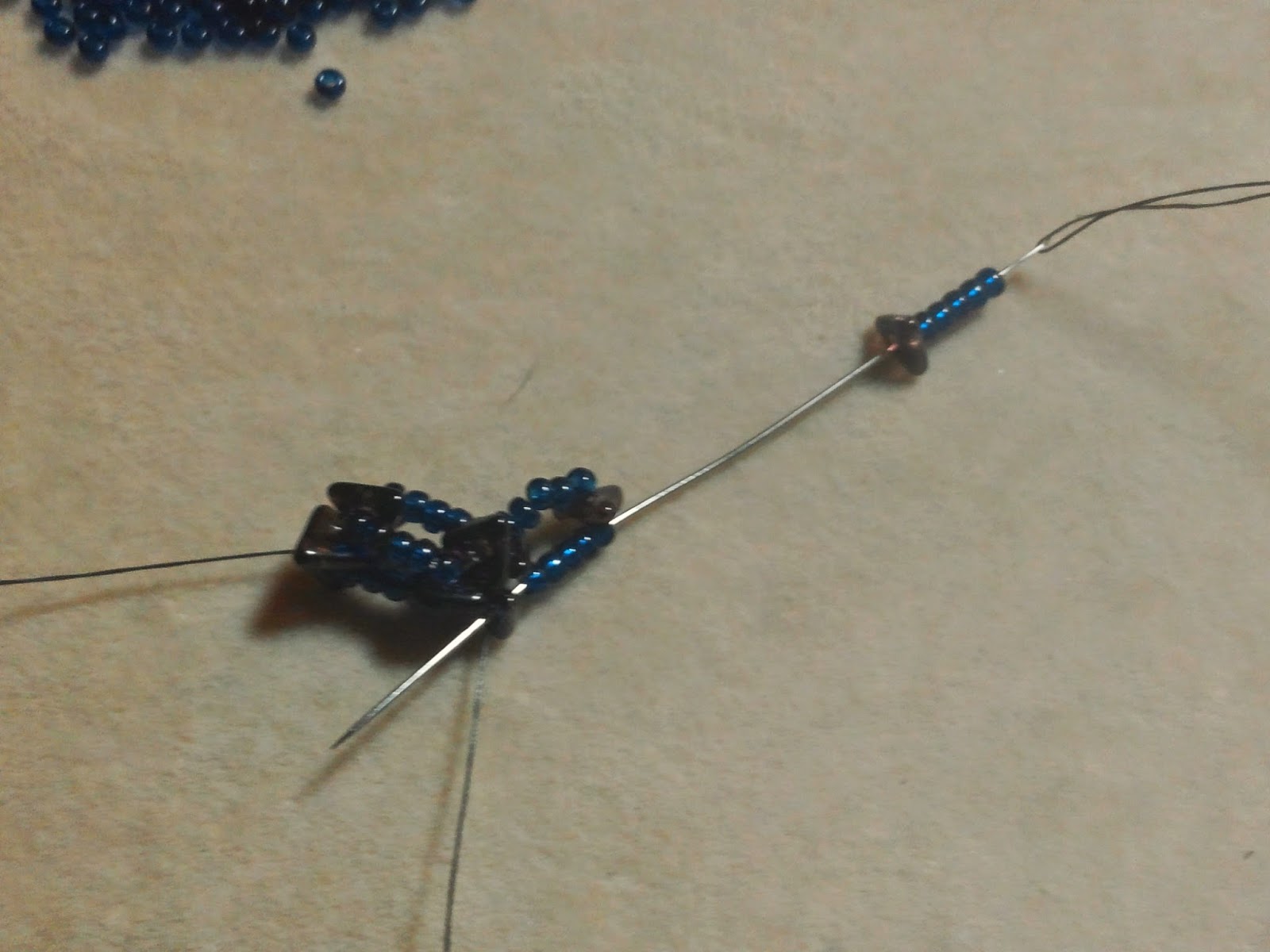
In my last two posts I have talked about my new attitude in designing as well as my current bead buying ban.  Both of those posts although I was talking positively about it came from a sad place at the time.  I have since discovered or rediscovered my beads!  And what a joy it is!


Yes my tray is a disaster but I have been finishing up designs that were started and for whatever reasons put aside.  Some of those reasons are things like I ran out of the beads the pattern called for or I got frustrated with the design.

I have actually been excited about beading lately.  I have found new ways to get past the frustration as well as gone back to look at those beads I HAD to have but haven't touched because another HAD to have got in the way.

I was inspired by these little dragon scale beads and made a matching bracelet for the necklace with Lesley's rose heart.

I am revisiting the long magatama's I was gifted by a dear friend and looked at them in a new way.

I actually think I will be looking into my UFO box for more inspiration.

I offer a challenge to you all.  Before you hit the buy button (but if you have the means hit it already) check out your own stash and revisit past unfinished designs see if you are inspired.


Wednesday, January 28, 2015

Design Dilemma

How do you design?  Do you look to others for approval when you design?  Do you follow trends in design to hopefully make sales?  Are you afraid to just go with your gut?

These questions have been on my mind lately.  To be honest as a beadweaver it is very hard to break the glass ceiling if you are looking to sell what you create.  When creating tutorials they have to be not only easy to follow but they have to also be something the market is looking for.

For example this was a great selling tutorial when the spike beads first came out. Now not so much since the market has been inundated with so many other new beads.

Then there is this tutorial that was a for lack of a better term a total bust. I used a unique technique to create the links but either the picture has not sparked any interest or it is just not what the market wants.  I am going to retake the cover photo with other color options and see if it helps.

It can really change your outlook as a designer.  This made me question each and every new idea I have had in design.  Making me look to others for advise and approval of even the simplest of ideas. As if out of the blue it hit me.  Why?  I love creating.  I love playing with seed beads and artbeads and these questions are making it no fun.  And frankly as I look back I realized some of my favorite and best designs happened when I was just following my instincts.
Taking Jennifer's Nightmare Insomnia bead and incorporating fun components.

Taking a new to me stitch and utilizing Sue's cab with my love of twins.

Tri beads are a new obsession and just let them create their own path to show off Diana's Snowflake.
Blu Mudd Design challenge that just inspired me to play.
 So you know this weekend is our reveal of January Component Stash challenge and I am over the top excited!  I really took this new revelation to the extreme and just went with my gut good and bad (you will not be seeing the bad though) and I am so happy with my designs.  Want a sneak peek?  I thought you would.


Have you changed the way you design?  Tell me how.

Wednesday, December 3, 2014

KISS Designing and a tutorial

How many times have you fallen in love with a bead and thought of all the elaborate things you could do with it and ended up putting it back in your stash because nothing you think of is right?  This happens all to often to me.  Then it hit me!

Keep It Simple Stupid!

Some beads need to just be the focal like this Treeman by Jenny.  I can not tell you how many times I have taken this out of the box only to place it sweetly back in because I can not make it work.

I have been so wrapped up in redoing our sons room, holidays and working on a design that is requiring a lot of research and step away time and I needed to complete SOMETHING.

On the Treeman necklace I used o-beads and beautiful AB lined olivine.  I used them all in the completion of the necklace.  What to do if I want to give you all a little tutorial?

No worried how bout showing you with tri-beads.  Yes I said tri-beads!

If you want to give this a go here is the step by step.

You will need:
 O-beads or Tri-Beads
 15gr size 11/0 seed beads

Pick up 5 11/0 beads, 1 tri-bead, 5 11/0 beads and 1 tri-bead

Go through the first 5 seed beads added

Pick up 1 tri-bead, 5 seed beads and 1 tri-bead

Go back through the beginning 5 seed beads, the tri-bead just added and the next 5 seed beads added in the beginning of this step.

Pick up 1 tri-bead and go through the the 5 seed beads in step one.

Pick up 1 tri-bead and go through the 5 seed beads at the start of this step.  

Pull beadwork snug and go through all the top tri-beads.

Using these tri-beads as the base for the next steps.

Pick up 5 seed beads, 1 tri-bead and 5 seed beads and go through the tri-bead from the beginning of this step in the opposite direction and the next tri-bead in the base.

Pick up 1 tri-bead and 5 seed beads and go back through the tri-bead you started from and the next tri-bead in the base.

Pick up 1 tri-bead and 5 seed beads go through the tri-bead you started from and the next tri-bead.

In this step you will go through the 5 seed beads on the other side of the tri-bead you just passed through.

Pick up 1 tri-bead and pass through the 5 seed beads to complete the side.  Go through the tri-bead in the base, back up through the 5 seed beads and through all the top tri-beads. 

Repeat these steps to create the length of chain you desire


Let me know what you think and if you do give it a go make sure to send me a link to it!


Wednesday, November 19, 2014

It happened. I am in a relationship.

So many times I see the new beads out there and look at them like "How hot are those".  Next comes looking at them on the Internet and flirting with the colors they come in.


Then comes the purchase and awaiting arrival like a first date.  All the anticipation and excitement.  Sometimes they are not all they seem to be up close.  This happened to me with gumdrop beads.  I love them and we had a couple of runs.


But things you thought you had in common just weren't there and you are left wondering what to do with them.  I just couldn't find the right way to play with them on my own.  It is a sad quick relationship.

Then sometimes you meet again unexpectedly with a new perspective and everything seems to fit. So it is time for that second date.  I was playing with some new tri beads I bought from Lisa Kan at Beadfest.


And had a thought.  What if I used them around my gumdrops.  How would that work?


I just started beading.  First came the round and how to keep it tight.  I stared at it for a while admiring the colors and texture and began thinking of how to take it further.  Well you all should know by now I love twins and superduo beads so naturally I reached for those.  Oh this time it was so awesome.  You both enjoy the time with excitement, fun and a few questions.  Oh where could this lead this time.  I likes very much the addition of superduos in the mix and how they played off the gumdrop.  Still not sure about the linking so we tried another date.


Yep the fun was still there but a few bumps in the road on this date. I have a love of true navy beads but they are so hard to come by. I had some beautiful Czech ones so I thought I would give it a go. Czech seeds can be smaller than Japanese seeds and this left a few gaps in the bezelling part. I will keep this one for me because of that. Hey what is a good relationship without a few potholes? So now what?

Well it happened. I have approached design with caution in the past. As well as my color choices. And always asked myself these questions:
  • How would another person perceive this?
  • Can I repeat it to create a tutorial? 
  • Do I want to repeat it?

Answers:
  • I don't care (which is such a step forward for me)
  • Maybe.
  • Hell yes because I am having so much fun!


I have honestly always wanted to try a green and gold color palette and I have to say I really like this combination. I have a few more colors of gumdrops and now all I need is more tri beads and for the first time I am enjoying repeating a design.

Will this relationship go even further? Will babies (tutorials) come from this design? What will happen if another bead shows its pretty face, will it be all over. Oh the dilemmas of relationships. I think I will enjoy where this relationship is for the moment.