Showing posts with label metal bench. Show all posts

Tuesday, November 19, 2013

Taking this show on the road...

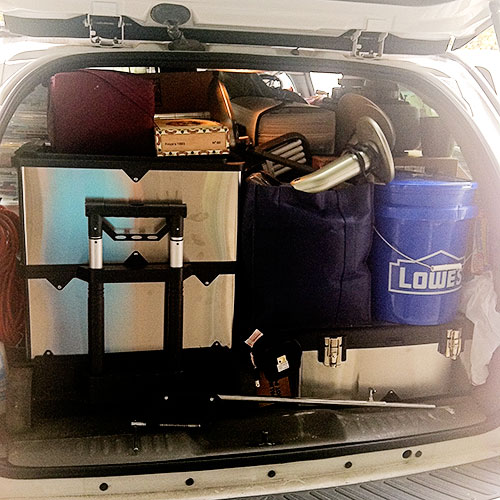
Regular readers of this blog may remember that in September, I drove to Washington state for a week-long metal retreat which I co-hosted with the very awesome and talented Melissa Muir. It was my first time making a long trip to do work elsewhere, and I was very challenged by the process of trying to figure out what I should take with me.

I think I took more than I really needed.

Road-Trip-9

Don't judge. And in my defense, my best friend Kimmy brought a few things.

But even the packing was a good learning experience. I thought I'd share with you my favorite travel accessory and my least-favorite, to give you some idea of what worked and what didn't work.
Road-Trip-8

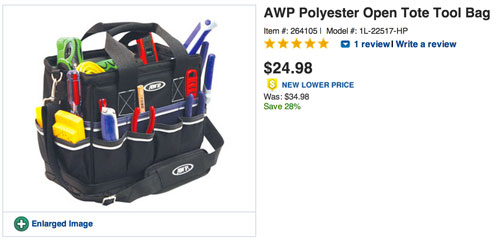
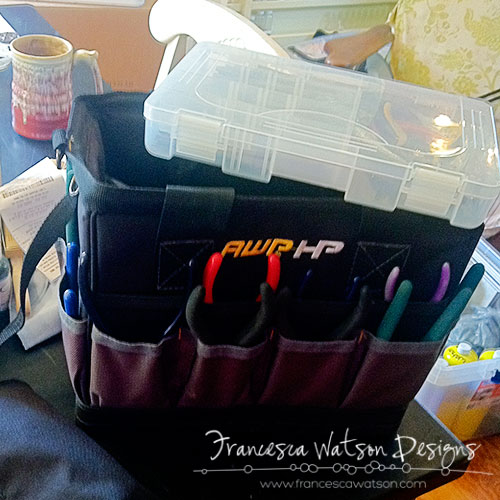
This AWP tool tote is one of my favorite non-tool purchases of the last year. It is extremely sturdy with a thick woven canvas stitched around a metal frame. The bottom and lower part of the sides is fitted with a rubberized coating that protects it from moisture, so you don't have to worry so much about where you set it down - just wipe it off! And as you can see, the price is right and it holds a TON of stuff.
Road-Trip-1

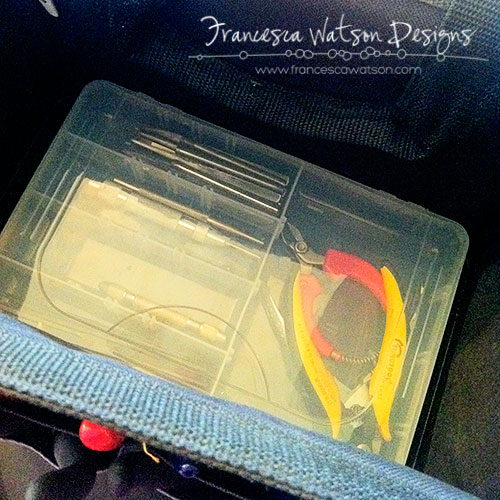
That plastic organizer is included, and it fits snugly in the bottom of the tote.
Road-Trip-2

I used it for small items and sharp items. There was plenty of room in the large open compartment for my punches and cutters, and I used the narrower areas on the left for my needle files, chasing tools, center punches and a pin vise.

Also included are two zippered bags that clip to the tote with a long lanyard.
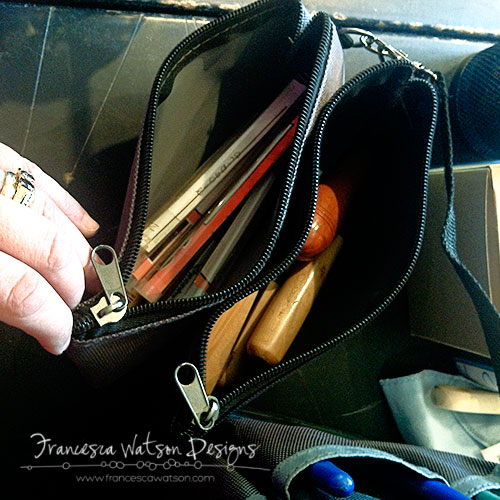
Road-Trip-3

I used one for all my saw blades and the other for my burnishers, ring clamp, and stone setting tools.

There are two tiers of pockets around the outside of the tote. The lower tier is gusseted, so they open a little wider than the upper tier, which are stitched closer to the sidewall of the tote. The pockets held literally all of my pliers, my favorite stubby hammer, Sharpies and more... with room left over.
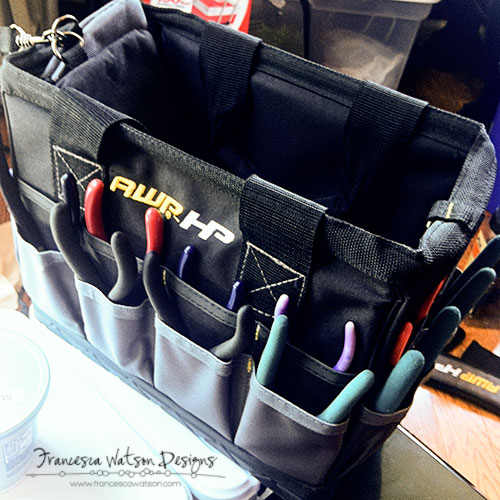
Road-Trip-4

In the main section, I was able to fit a bench block, all my sanding and finishing materials, some work towels and last minute odds and ends. Since I got back, with my studio packed up for the move, I've rearranged it and the center section now holds a bench block, a sand bag, sanding materials, a saw frame, a bench pin/anvil combo, my magnifiers, and an assortment of hammers wrapped up for travel. I took this with me to the Richard Salley class I took recently, and it had literally everything I needed to do the projects. I am an enthusiastic fan of this tote, especially given its $25 price tag.

Now, here's something that worked a little less well:
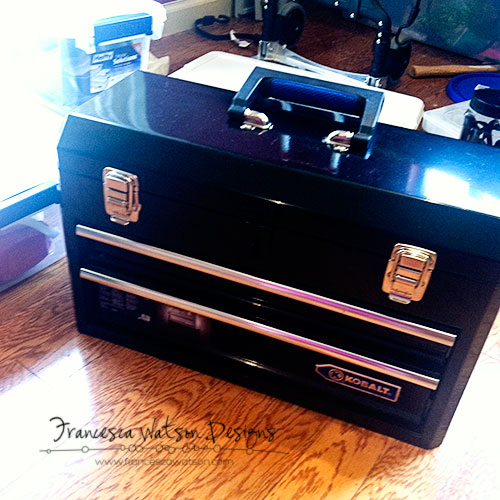
Road-Trip-7

Kobalt has a steller reputation for high quality products, and in general I'm a fan. I got this tool box because I wanted something sturdy that could transport my metal bench items, and it certainly had plenty of room.

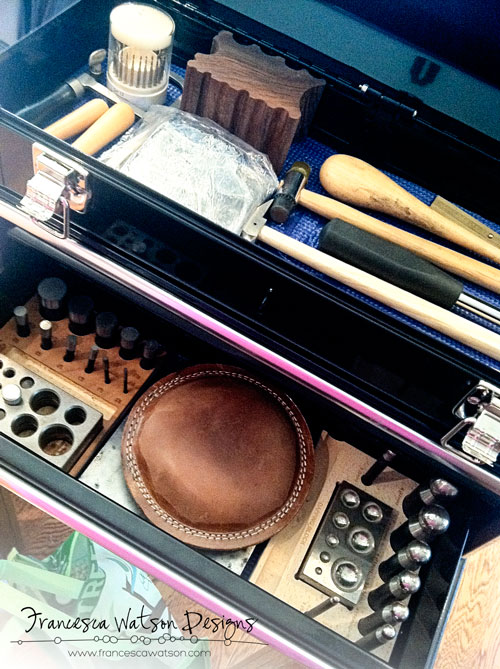
Road-Trip-6


Road-Trip-5

Here's the problem, though. All that metal bench stuff? It's really (REALLY) heavy. Really heavy. Once I loaded this up (and packed a bunch of shop towels in the drawers to keep things from moving around) it was too heavy for me to lift - and I was really nervous that the plastic handle on the top of the lid would just snap off. I managed to get it on a dolly and muscle it down the stairs and into the car, but it was not in the least bit convenient. I will say that having it next to my worktable created some good organizational space, but overall it wasn't a good fit for travel. To be clear, the problem was that I was loading the toolbox up with more stuff than it was designed to carry, so the problem isn't with Kobalt. That said, I would recommend they consider making this toolbox with a sturdy metal handle (perhaps with a rubberized grip) instead of the plastic.

So while I'll probably repurpose the toolbox for our household tools, I am an enthusiastic fan of the AWP tote. Since I can't afford to own two sets of my most-used tools, I'll be using it a LOT to transport things to and from the new studio when I need to work at home. And, of course, there's always NEXT year's metal retreat!

How about you? Do you have a favorite travel accessory for tools and materials?

Until next time!


Tuesday, June 18, 2013

Product Review: Mighty Punch

My name is Francesca, and I am a tool-o-holic. If it has to do with punching, piercing, sawing, hammering, forming or forging metal, I promise you I have drooled over it in a magazine or online. (I'm not the only person with a Rio Grande catalogue on my coffee table, am I??)


But in spite of my affinity for all things metal-tool-related, I skipped over this tool more times than I can count. It doesn't look very sexy (at least when compared to a Fretz hammer, my current unrequited love), and I have a perfectly good set of Pepe disc cutters that I love (and use) a lot. "Pooh-pooh," I said. "Who needs a set of hole punching pliers?"

Turns out I did.

I love putting holes in metal. I have some good hole-punch pliers that I use a lot, including a pretty good parallel hole punch plier that is my go-to for wire-sized holes when I'm doing homemade rivets. But anything larger than that has always required using my disc cutters - and as much as I love them, they leave a burr on the side opposite the cut that requires cleanup and multiple blows with a hammer. They're wonderful for when I'm actually cutting discs, but not so great when what I'm after is the hole. Enter the Mighty Punch (or the Power Punch, as some models are called).

Holes and dots made with my Mighty Punch and a plain center punch.
Y'all. I am in love.

Here's the summary: This tool punches perfect holes that require almost no cleanup, in seven sizes ranging from 3/32" to 9/32". It does not distort the metal at all, which is a big deal for me, though it does leave a dimple on the disc that is removed. And although it took me a little time to figure out, it's very easy to operate.

The tool comes in a plastic case to hold all the parts. It includes the plier itself; seven die sets; and a flat metal tool for unscrewing the screws and the die sets. It has two drawbacks. The first is that it is large and heavy, and a little unwieldy. It is definitely not possible to operate this with one hand.


The second is that swapping out the die sets is a little "fiddly" (to borrow a term from my UK friends!), at least initially. I include this as a drawback, because it might be off-putting to some of you, but honestly, once I figured it out and practiced a couple of times, it wasn't bad at all.

Flat metal tool included to unscrew screws and dies.

Once loosened, the screw comes out easily with your fingers.

Pull the top handle back...
... then drop the lever arm (which you previously unscrewed) out and down.

Now the punch is loose in the shaft...

... and can be pulled out with your fingers.

The die screws in and out of the bottom of the pliers with your fingers too.

The punches and dies come in matching sets.
Punching the holes is pretty easy too. It's a good idea to use a center punch to mark the center of the hole you want to cut out - each of the dies has a small point in the center of the cutting face, and the punch mark will give it a "home base" when you're lining up your metal.


I've found it easiest to line up the metal to punch by turning the tool sideways and bracing the bottom handle in my cleavage. (Hey - just being real here). As a lefty, I use my left hand to work the top handle and my right to position and hold the metal that I'm punching. The temptation then is to brace one of the plier handles against a table or bench top and press down, but I promise that will earn you pinched fingers and a bent piece of metal. Much easier is to hold one handle in each hand, hold it at chest level, and press your hands together. (Remember "we must, we must, we must increase our... "? Like that.) The dies cut through even heavy gauge metal very easily and no pinched fingers!

20 gauge copper sheet can be punched with just a little effort.

After making the hole, the opening action of the handles pulls the metal cleanly off the punch.

Clean, perfect, distortion-free hole with a very slightly beveled edge.

Works on thinner sheet too, without distortion.


See? No distortion on thick or thin sheet. Clean holes with a tiny little bevel on the cut edge - cleans up with a few swipes of sandpaper. The tool also has a depth gauge if you're trying to do precise punches, but to be honest I've never used it. It's adjustable, so I just moved it back and out of the way. It's not a feature I've ever used.

So, in short, I am very happy to recommend this tool to anyone who works with metal a lot. It's terrific for cold connection projects, but I use it mostly for adding design elements. I've found it under two names: Beadsmith's Mighty Punch and Euro Power Punch. Prices range from $41 to $52, and in my opinion it's worth every penny. I have the Beadsmith version and I've been really happy with it. It gets a ton of use on my bench and has stood up to it well - the punches have stayed sharp, but if they were ever to fail, replacement punches are available.

This is one of my favorite recent tool additions to my bench - what's yours?

Until next time!


NOTE: I am not affiliated with Beadsmith or any other manufacturer and I have not been compensated for this review. All opinions are my own.